The year 2026 has brought us to a fascinating crossroads in the personal audio market. For years, the dominance of the Apple AirPods Pro has seemed almost insurmountable, particularly for those deeply embedded in the iOS ecosystem. However, the release of the Sony WF-1000XM6 marks a significant moment where technical prowess and audio engineering attempt to bridge the gap. While the AirPods Pro remain a formidable opponent due to their seamless integration, the XM6 emerges as a high-fidelity alternative that prioritizes sound sculpture and cross-platform flexibility over pure ecosystem convenience.
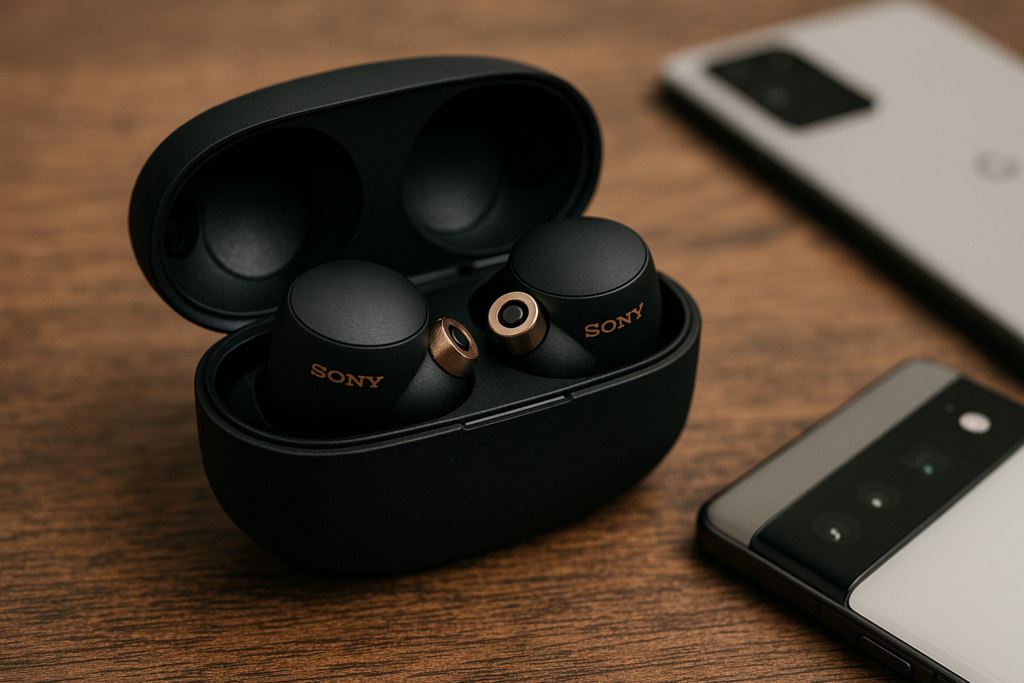
Sony’s latest offering isn’t just a minor iteration; it is a calculated response to the feedback from the previous generation. With a redesign that makes the earbuds 11% slimmer and a case that is more pocket-friendly, the physical refinement of the XM6 is immediately apparent. But the real story lies beneath the surface, where a new 32-bit signal processor and an 8.4mm driver array promise a level of audio detail that standard consumer buds often struggle to achieve. For the audience at Telcocast, the question isn’t just about whether these are “good,” but whether they justify their premium price tag in a market saturated with options.
Ergonomics and the Shift to Stemless Design
One of the most striking differences between the Sony WF-1000XM6 and the AirPods Pro is the fundamental design philosophy. Sony has doubled down on the stemless, “bean-style” architecture, which provides a low-profile look and a snug fit that many users find superior for high-intensity activities. The inclusion of specialized memory foam tips ensures that the earbuds form a custom seal within the ear canal, providing both physical stability and passive noise isolation. This makes them an excellent choice for users who find traditional silicone tips to be slippery or uncomfortable during long sessions.
However, the stemless design does introduce a learning curve for controls. While the AirPods Pro utilize a “pinch” gesture on the stem—which many find more tactile and intentional—the XM6 relies on touch-sensitive surfaces. While Sony has refined these sensors to be less prone to accidental triggers, there is still an inherent risk of pauses or mode-switches when simply adjusting the fit. Despite this, the trade-off is a device that feels lighter and more integrated into the ear, making it a preferred option for those who value a minimalist aesthetic.
Audio Engineering and the 32-Bit Revolution
Where the Sony WF-1000XM6 truly begins to pull away from the competition is in its sonic capability. Sony collaborated with Grammy award-winning engineers to tune the XM6, focusing heavily on mid-range clarity and low-end definition. The result is a soundstage that feels remarkably wide for a pair of wireless earbuds. Vocals and instruments are given room to breathe, avoiding the “boxy” or compressed sound often associated with Bluetooth audio. This is further enhanced by the Sony Sound Connect app, which offers a full 10-band equalizer, allowing users to move beyond the manufacturer’s default tuning.
For Android users, the advantage is even more pronounced thanks to LDAC support. While not fully lossless, LDAC allows for a much higher bitrate than the standard AAC codec used by Apple. When feeding the XM6 with high-resolution source material, the audio becomes richer and more textured, revealing nuances in complex tracks that are often lost on other hardware. It is this commitment to high-fidelity wireless audio that makes the XM6 the “audiophile’s choice” in the 2026 earbud market, even if it requires stepping outside of the Apple garden to fully appreciate.
Noise Cancellation: The Industry Benchmarks
Active Noise Cancellation (ANC) has long been a Sony stronghold, and the WF-1000XM6 is claimed to be 25% more efficient at blocking ambient sound than its predecessor. In real-world testing, the XM6 excels at neutralizing low-frequency hums and mid-range chatter, such as the environment of a busy café or a transit hub. The “Auto Ambient Sound” feature is particularly impressive, as it intelligently adjusts the level of noise cancellation based on the user’s surroundings. This active adaptation ensures that the silence feels natural rather than oppressive.
Yet, even with these advancements, the AirPods Pro 3 still maintain a slight edge in pure ANC and transparency mode fidelity. Apple’s transparency mode remains the gold standard, providing a “passthrough” effect so natural that users often forget they are wearing earbuds at all. While the Sony XM6 has improved significantly in this area—making it perfectly adequate for phone calls and situational awareness—it still feels like a digital reproduction of the world rather than a transparent window. For the user who prioritizes being aware of their environment as much as blocking it out, this remains a critical point of comparison.
The Verdict for 2026: Performance vs. Ecosystem
Choosing the Sony WF-1000XM6 over the AirPods Pro ultimately comes down to a choice of priorities. If you are an iPhone user who values the “it just works” philosophy—automatic device switching, Find My integration, and the industry’s best transparency mode—the AirPods Pro remain the logical choice. They are built for the ecosystem first and foremost. However, the Sony XM6 is not trying to be a “better AirPods.” It is trying to be a better pair of headphones.
The XM6 offers superior sound customization, a more secure fit for active lifestyles, and a high-resolution codec that outclasses what Apple currently offers. For Android enthusiasts or platform-agnostic users, the Sony WF-1000XM6 is arguably the best all-around earbud on the market today. It delivers a professional-grade audio experience in a compact, durable form factor that proves Sony is still the king of technical innovation in the personal audio space.